Print at Actual size / 100% with browser headers and footers turned off. Only whole systems that fit are drawn; reduce the system count or spacing if you need more room.
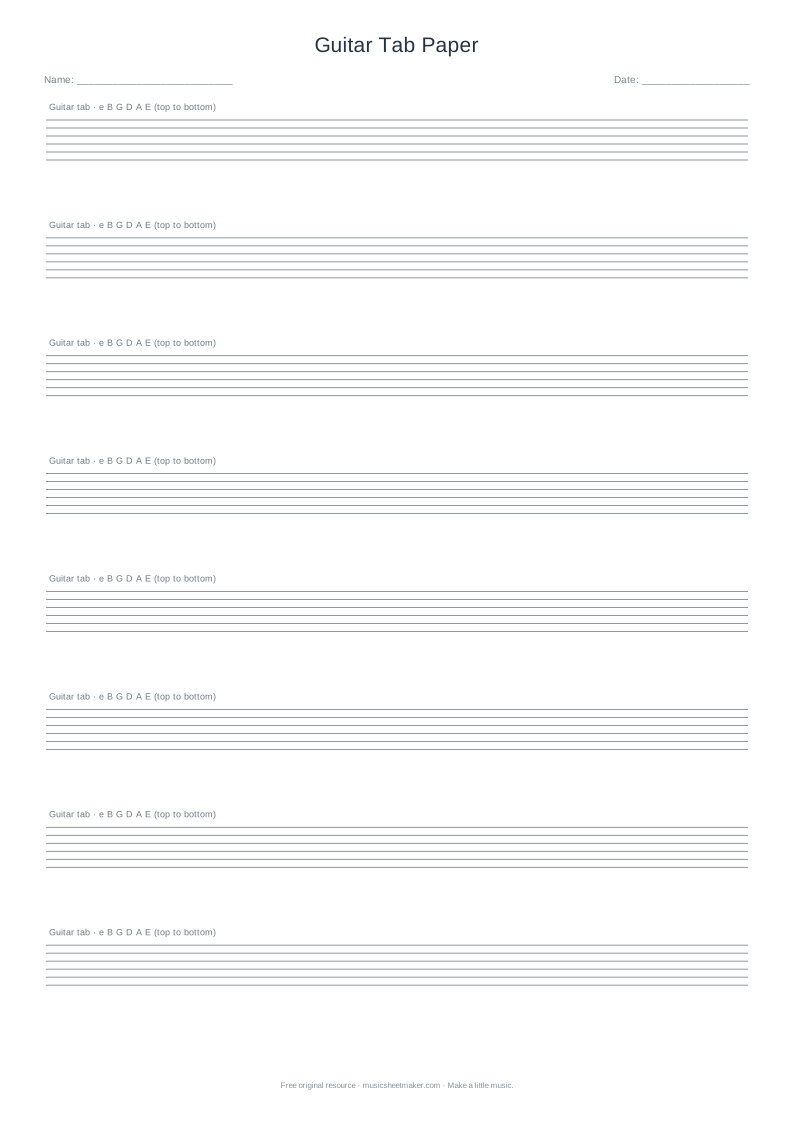
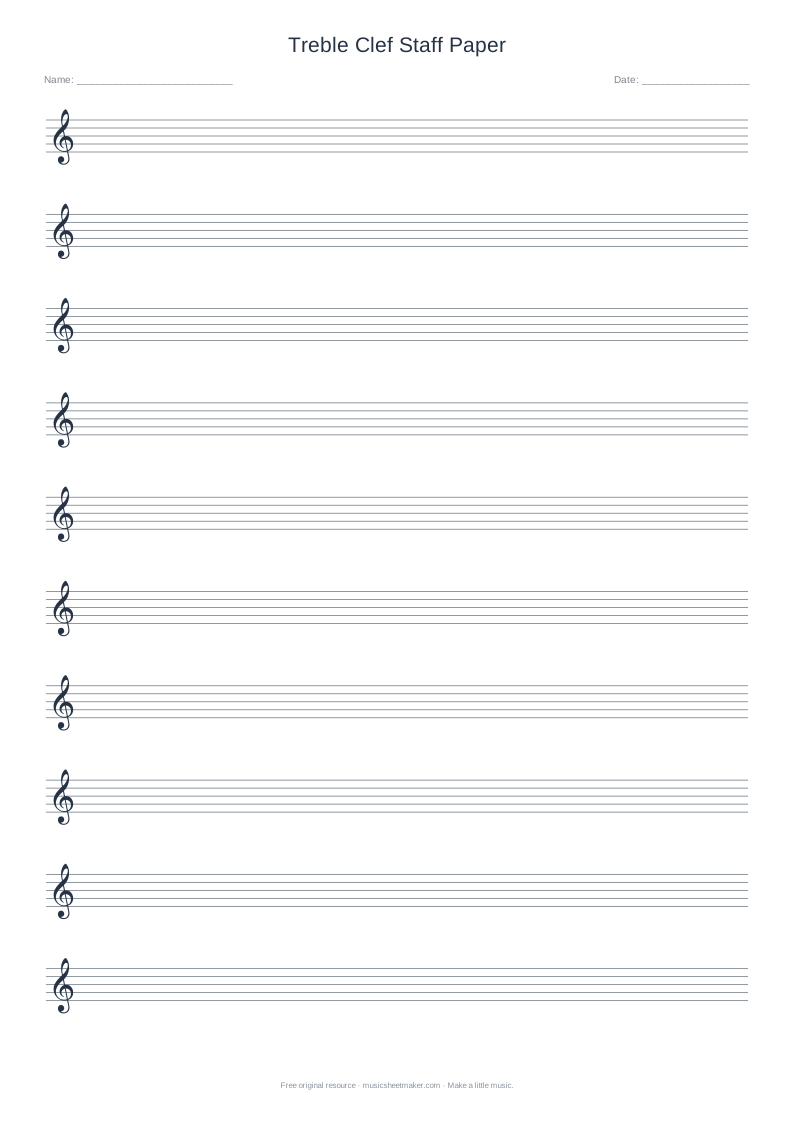
Keep guitar rhythm and fingering aligned on paired staff and tab
Print treble notation above six-line guitar tab when a musical idea needs both rhythm and a specific fingering. Fill in both parts by hand and align matching events vertically. The paired layout helps you compare pitch notation with physical string and fret choices before sharing the phrase.
- Printed layout
- Five-line treble staff above six-line tab
- Starting settings
- 5 paired systems, Standard spacing, A4
- Tab orientation
- High e, B, G, D, A, low E from top
- Pitch convention
- Guitar treble notation sounds one octave lower
Start in three steps
- 01
Plan a complete pair
Choose spacing and system count with room for note stems, tab numbers and annotations.
- 02
Download the right paper size
Select A4 or Letter and export the current PDF or scalable SVG.
- 03
Check the matching positions
On a test print, place one upper note and its tab number directly beneath it.
Use each half of the system for a clear purpose
The upper staff provides five lines and a treble clef. Use it for note pitches and durations. The lower system provides six tablature lines. Use those for the string and fret choices. A note and its matching fret number should begin at the same horizontal position. That alignment tells the reader that the two markings describe the same event.
In standard tuning, the tab lines run from high e at the top through B, G, D and A to low E at the bottom. Standard guitar notation commonly uses treble clef with a sounding pitch one octave below the written note. This blank template does not apply that convention for you. Write consistently and explain the convention if the sheet will be read by a learner or by another instrument.
Translate a familiar note in both directions
Begin with an open first string. Its sounding pitch is E4; in conventional octave-transposing guitar notation it is written as E5. Place the written note on the treble staff and a zero on the top tab line directly underneath. Then try the first and third frets on that string. Check each pitch on the instrument instead of relying only on a memorised shape.
For the reverse exercise, write a short rhythm on the staff and ask the learner to find a practical fingering for it. The same pitch can often be played on more than one string. Compare two choices and consider the surrounding phrase. A solution that is possible for one isolated note may be awkward when followed by a shift, a chord or a sustained voice.
| Start beat in 4/4 | Written treble note | Matching tab and duration |
|---|---|---|
| 1 | E5 | High E string, fret 0; half note |
| 3 | F5 | High E string, fret 1; quarter note |
| 4 | G5 | High E string, fret 3; quarter note |
These written E5, F5 and G5 sound E4, F4 and G4 on guitar. A piano reading the same ordinary treble pitches would sound an octave higher.
Let the staff carry the timing information
One advantage of this format is that the fret numbers do not have to communicate duration alone. Show the rhythm clearly on the upper staff, with rests and bar lines as needed. Keep the tab aligned with those events. If a note is held while another note begins, take extra care with its notation rather than squeezing both instructions into an unexplained horizontal gap.
Try a one-bar exercise containing a half note and two quarter notes in 4/4. The upper durations show that the first event occupies two beats. Beneath it, position the first fret number at beat one, then align the remaining numbers with beats three and four. Count aloud while following both lines. This is a simple way to test whether the two representations actually agree.
Make the connection an active learning task
A teacher can supply the standard notation and leave the tab for the learner, or provide the tab and ask for note names and durations above. Work with a small range at first. The goal is to connect fretboard knowledge with notation, not to make the exercise difficult in every possible way. Include a short answer example so the required level of detail is clear.
For composition, use the top staff to preserve your melodic and rhythmic intention while testing fingerings below. Circle a position change or mark an alternative instead of overwriting a choice you may want to revisit. Add string numbers, fingerings or a brief technique instruction only when they clarify performance. Too many different marks can conceal the musical line you are trying to communicate.
Leave enough room between the paired staves
This layout uses more vertical space than either tab or standard staff paper alone. Start with a modest system count, especially if the music needs ledger lines, bends or explanatory words. Change the title, paper size and spacing in the controls, then check the preview. The generator keeps complete pairs together and draws only the number that fits.
Choose the A4 or US Letter download that matches your printer. Disable browser headers and footers and inspect the page at Actual size or 100%. If you insert the SVG into another document, keep its proportions and test the physical output. Lines that look clear on a large monitor can become too close together when the document software automatically shrinks the image.
Check the relationship before sharing the sheet
Read the notation and tab independently, then play them together. Check the tuning, capo instructions, octave convention and each bar’s rhythmic total. Make sure an accidental in the staff agrees with the chosen fret. A wrong fret number may still produce a plausible sound, so listening alone is not enough to verify that both written versions match.
This printable does not convert between staff and tab, identify a guitar tuning or transcribe a recording. It is a clear surface for your own musical decisions. The original layout is free for personal study, lessons and classroom handouts under the site’s terms. When the notes come from an existing song or arrangement, check the permissions for that material separately before reproducing or distributing it.
Guitar Tab & Staff Paper: frequently asked questions
Why does the same pitch have several tab positions?
The guitar’s string ranges overlap. A pitch can often be reached on a different string at another fret. Tablature preserves the fingering you choose, while standard notation preserves the written pitch and duration. Choose a position that suits the entire phrase, not only a single note.
Does this page automatically fill the tab from notation?
No. Both parts of the page are blank and are completed by hand. The paired structure makes your comparison clearer, but it does not calculate fingerings or resolve octave conventions. Check the result on the instrument before giving the page to another player.
Can I print this for a guitar class?
Yes. You may print and adapt the original blank layout for lessons and classroom handouts. Add your own exercise or material you have permission to use. Make a test copy first so the staff and tab remain large enough for the learners’ handwriting.