Print at Actual size / 100% with browser headers and footers turned off. Only whole systems that fit are drawn; reduce the system count or spacing if you need more room.
Count rhythm onsets while keeping the full 4/4 pulse moving
Print original 4/4 rhythm exercises with a separate answer view marking note and rest onsets. Clap, tap or play one pitch while maintaining the underlying count. The default includes eighth notes and rests; use the worked example below to distinguish a new attack from a note that continues sounding.
- Starting worksheet
- 6 systems, 3 measures each, in 4/4
- Default vocabulary
- Half, quarter and eighth notes, with rests
- Checking format
- Onset counts; & marks eighth-note offbeats
- Page controls
- Title, size, systems, spacing and answer view
Start in three steps
- 01
Save the exercise view
Choose A4 or Letter, set the layout and download the current PDF.
- 02
Save a matching answer view
Switch to Answer key without changing the other settings, then download again.
- 03
Count before checking
Print at Actual size, attempt one measure and explain each onset before comparing.
Read the meter before the first symbol
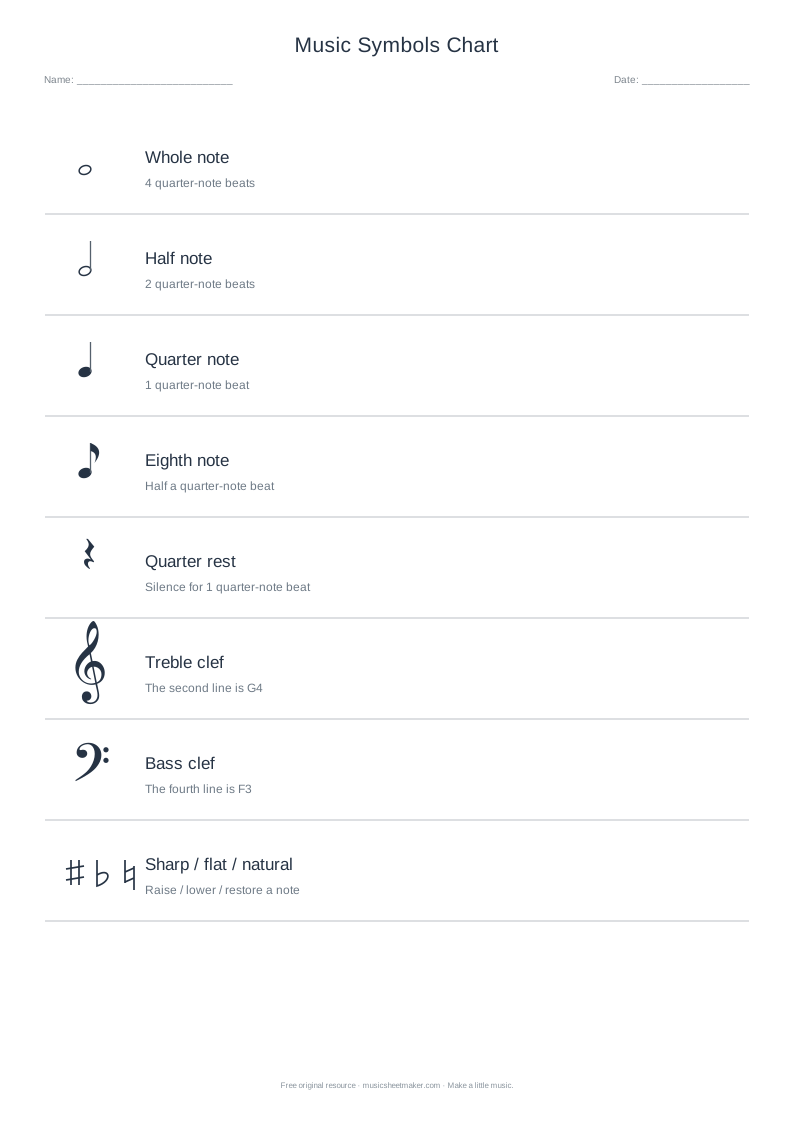
The prepared worksheets use 4/4: four quarter-note beats in a complete measure. A quarter note occupies one of those beats, a half note occupies two, and an eighth note occupies half a beat. Rests occupy time too. The rhythm is not complete merely because the sounding notes add up to something familiar; silence must also fit the measure.
Read one bar before trying a whole line. Find its note values, locate any rests and check that the total is four quarter-note beats. The staff gives the pattern a conventional notation framework, but pitch is not the main task here. Clap or tap on one surface so you can focus on timing without also reading a melody or finding finger positions.
Count attacks and held time separately
Try a bar with a quarter note, two eighth notes and a half note. Its values are one beat, half a beat, half a beat and two beats. Count “1, 2 and, 3–4” while keeping the underlying quarter-note pulse steady. The final half note starts on beat three and continues through beat four; it is not a new attack on every counted beat.
The answer view labels the beat or offbeat where each printed event begins. An ampersand marks an offbeat in the simple eighth-note framework, and a rest label identifies a silent event. These labels are onset guides, not a full transcription of every spoken subdivision. Keep counting through long notes and rests even when no new symbol begins on that count.
| Event | Begins on count | Quarter-note duration |
|---|---|---|
| Quarter note | 1 | 1 |
| First eighth note | 2 | 0.5 |
| Second eighth note | 2 & | 0.5 |
| Half note | 3, then hold through 4 | 2 |
| Measure total | Four quarter-note beats | 4 |
The custom answer view prints an ampersand for an offbeat rather than repeating the preceding beat number. The table writes ?2 &? to explain which offbeat it means.
Move from speaking to playing in small steps
Start by speaking the count without clapping. Then tap the quarter-note pulse with one hand while speaking the rhythm. Next, clap only the written attacks while maintaining the count. Finally, play the same pattern on one comfortable note. If the task falls apart after adding the instrument, return to the previous step rather than immediately increasing the tempo.
Choose a metronome setting slow enough to leave time for the smallest values. Eighth notes still divide a beat evenly at a slow speed; they should not become a quick pair followed by an unexplained pause. Keep the pattern’s shape consistent as the tempo changes. A correct rhythm played slowly is a more useful result than a fast attempt that loses a rest or compresses a held note.
Use the answers to start a conversation
Give learners the exercise view first and keep the answer sheet separate. Ask them to mark onsets or explain one measure aloud before comparing their work. If an answer differs, identify whether the problem is a duration, an offbeat or a silence. This is more informative than marking an entire line wrong without locating the first point of disagreement.
In a group, divide the class into a steady-pulse part and a written-rhythm part, then exchange roles. Another activity is to let a learner choose one bar for the group to echo. Keep the vocabulary within what the class has already met. Use the custom rhythm worksheet generator when you need a particular meter or different settings instead of treating every prepared pattern as suitable for every level.
Prepare a clean exercise and a matching answer copy
The page controls let you change the title, paper size, system count and staff spacing. Switch between Exercises and Answer key to download or print the view you need. Keep the settings consistent between those two copies so the learner’s page and your checking page have the same layout. The ready-made download is a prepared resource for the selected paper size.
For new patterns or control over the rhythm vocabulary, open the rhythm worksheet maker. Its settings can vary meter, eighth notes and rests. This prepared printable is designed as a ready starting point rather than a complete progressive curriculum. Inspect the actual symbols before assigning the sheet and explain any unfamiliar value or notation convention before asking for independent work.
Print at a size that preserves rhythm details
Choose A4 or US Letter according to the loaded paper. Use the matching PDF, disable browser headers and footers, and check the print preview. Actual size or 100% usually preserves the intended spacing. Make sure flags, rests and counting labels remain distinct. A faint or heavily reduced copy can turn a reading exercise into a guessing exercise.
Print one test before copying for a group, then keep the downloaded exercise and answer files together. These original worksheets are free for personal practice, lessons and classroom handouts under the terms. They do not listen to a performance, grade timing automatically or teach every possible rhythm. For more complex subdivisions, tuplets, ties or compound-meter study, use an appropriate lesson and material designed for that specific concept.
Rhythm Practice Worksheets: frequently asked questions
Why is a long note labelled only at its beginning?
The answer view identifies onsets. A half note beginning on beat three continues for two quarter-note beats, so it does not need another onset label on beat four. Keep the internal count moving through the held duration even though the sound is not attacked again.
Can I make a sheet with a different meter?
Use the rhythm worksheet generator for meter and vocabulary choices. The prepared resource is based on 4/4. Before switching tasks, explain how many quarter-note beats belong in the new measure and verify that the learner understands the smallest note value included.
Can learners check their own work?
Yes. Have them attempt the exercise first, then compare with a separately printed answer view. Ask for an explanation of the count, not only a copied label. If the timing still feels uncertain, speak, tap and clap the pattern slowly before returning to the instrument.